Published on 16 March 2026 Hip surgery
Why does dancers’ hips wear out prematurely?
For a dancer, the hip is the mechanical structure that supports artistic creation. Yet behind the aesthetic perfection of turnout or a grand jeté lies a harsh biomechanical reality. Why do some artists, at the peak of their careers, face the prospect of a hip replacement before the age of 40? We encounter this paradox daily: how does a joint designed for mobility become the site of premature degeneration (early hip osteoarthritis), and how does modern hip surgery now transform what was once a career-ending diagnosis into an artistic rebirth?
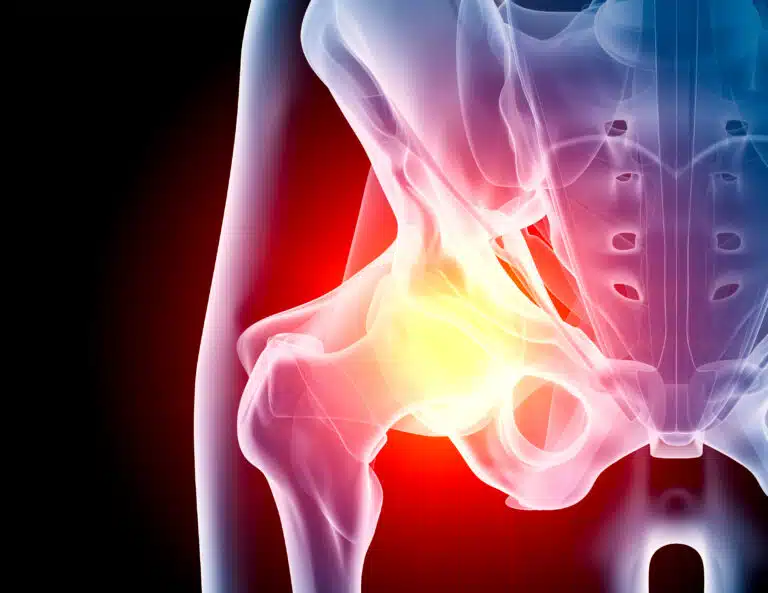
Tthe mechanics of movement: when dance challenges anatomy
The hip is a ball-and-socket joint designed for both stability and motion. However, classical ballet demands ranges of motion that exceed physiological limits. Repeated microtrauma ultimately damages the core engine of the hip: the articular cartilage.
- Forced turnout: The pursuit of extreme external rotation generates repetitive joint microtrauma
- Hypermobility: While flexibility is an asset, it creates instability, leading to labral and cartilage injuries
- Impact loading: Landings from jumps and lifts produce substantial mechanical forces, particularly on weight-bearing cartilage
The artistic objective (the pursuit of perfect movement) often drives dancers beyond their joint tolerance threshold. This imbalance between aesthetic demands and mechanical stress explains why hip degeneration occurs more rapidly in this population.
Common hip pathologies in dancers
Femoroacetabular Impingement (FAI)
Abnormal contact between the femoral neck and the acetabular rim creates a bony conflict that progressively damages cartilage. It is a major risk factor for early hip osteoarthritis (before age 40).
Labral Tears
The hip labrum (often compared to a “meniscus”) may fissure, causing sharp groin pain.
Hip Dysplasia
This often congenital bony malformation leads to accelerated joint wear.
Early Hip Osteoarthritis (Early Coxarthrosis)
Cartilage degradation results in pain, stiffness, and loss of range of motion.
In the presence of suggestive hip symptoms, specialized consultation is essential. Advanced imaging (CT arthrogram, 3-Tesla MRI) enables early detection of joint lesions. Appropriate medical and/or surgical management aims to halt or slow progression toward irreversible joint destruction.
Aggravating factors
Premature hip degeneration is not inevitable, but certain risk factors inherent to professional dance accelerate wear:
- Joint morphology: Congenital dysplasia or acquired cam deformity (leading to FAI) act as catalysts for early degeneration
- Joint hypermobility: Excessive laxity may destabilize the joint (hip micro-instability), increasing vulnerability to injury
- Repetition intensity and frequency: Professional dancers repeat the same movements for hours daily
- Technical errors: Forced postures, excessive extensions, and extreme external rotations generate repetitive microtrauma throughout a career
Preventive programs developed by dance medicine specialists, incorporating muscular strengthening and postural correction, can significantly reduce injury risk. When structural abnormalities are identified, specialized surgical consultation becomes necessary.
Long-term consequences
Hip degeneration (coxarthrosis) can significantly impact a dancer’s professional career and quality of life. Chronic pain, stiffness, and loss of range of motion limit performance and, in severe cases, may lead to premature career termination.
Anatomically, early degenerative lesions may appear as early as ages 30 to 40. For some dancers, only surgical intervention can restore mobility and relieve pain.
Returning to the opera: is it truly possible?
For decades, hip replacement meant definitive retirement from dance. Today, that dogma has been overturned.
Professional ballet dancers treated within our team have returned to elite performance levels before age 40. This success relies on three pillars:
Muscle Preservation : Using minimally invasive approaches that do not cut muscles (direct anterior approach), we preserve muscular integrity ; essential for dancers.
3D Planning : Preoperative evaluation of bone and joint geometry identifies anatomical abnormalities not visible on standard radiographs.
Custom Implants : A patient-specific femoral stem restores each dancer’s unique anatomy, joint length, neck-shaft angle, femoral offset, and femoral neck anteversion.
Our prevention recommendations
For a sustainable career, a multidisciplinary approach is essential:
- Stability before flexibility: Strengthen stabilizing muscles (especially gluteus medius) to protect the joint
- Proper warm-up and stretching: Progressive warm-up reduces microtrauma
- Cross-training: Alternating dance disciplines modifies cartilage load distribution
- Monitor pain: Groin pain is never “normal.”
FAQ
Can you dance with early osteoarthritis?
Yes, under certain conditions. Movement adaptation, strengthening programs, and regular medical monitoring are essential.
Does a hip replacement limit range of motion?
No. When planned in 3D with a custom stem and performed by an expert, it can reproduce the range required for high-level performance.
How can I tell if my hip is deteriorating due to dance?
Groin pain, discomfort during rotation, or persistent stiffness are warning signs. Specialized consultation and imaging can confirm early degeneration.
Will all dancers eventually need a hip replacement?
No. Only cases of advanced degeneration (coxarthrosis) require surgery. When necessary, a personalized total hip replacement allows return to dance in our experience.
References
- Agricola, R. et al. (2020). Femoroacetabular impingement and hip osteoarthritis in dancers. BJSM.
- Khan, K. M., et al. (2021). Dance and the Hip: Biomechanical and Clinical Considerations. Clinical Orthopaedics and Related Research.
- Nogier A, Tourabaly I, Barreau X, Ramos-Pascual S, van Rooij F, Saffarini M, Courtin C. (2022). Little or No Differences in Hip Morphology Between Professional Dancers and Controls: A Systematic Review. Clin J Sport Med.
- Nogier A, Tourabaly I, Ramos-Pascual S, Barreau X, Baraduc E, Saffarini M, Courtin C. (2023). Excellent Clinical Outcomes and Return to Dance of 6 Active, Professional Ballet Dancers Aged Younger Than 40 Years at Total Hip Arthroplasty Through Direct Anterior Approach With a Custom Stem: A Case Report. Clin J Sport Med.
- Nogier A, Tourabaly I, Ramos-Pascual S, Saffarini M, Baraduc E, Barreau X, Courtin C. (2023). High Rates of Satisfaction and Return to Dance in Current or Former Professional Ballet Dancers After Total Hip Arthroplasty With a Muscle-Sparing Direct Anterior Approach Using Custom Femoral Stems. Orthop J Sports Med.
- Barreau X, Courtin C, Ramos-Pascual S, Kumble A, Saffarini M, Nogier A. (2024). Epidemiology of Musculoskeletal Injuries in Professional Ballet Dancers at the Opéra de Paris. Clin J Sport Med.