Published on 02 March 2026 Hip surgery
Hip osteoarthritis (coxarthrosis): symptoms, causes and treatments
Hip osteoarthritis, also known as coxarthrosis, is one of the most common joint disorders. It is characterized by progressive cartilage degeneration, leading to pain and stiffness. Contrary to common belief, it does not affect only older adults: young, active individuals and athletes may also develop premature cartilage wear.
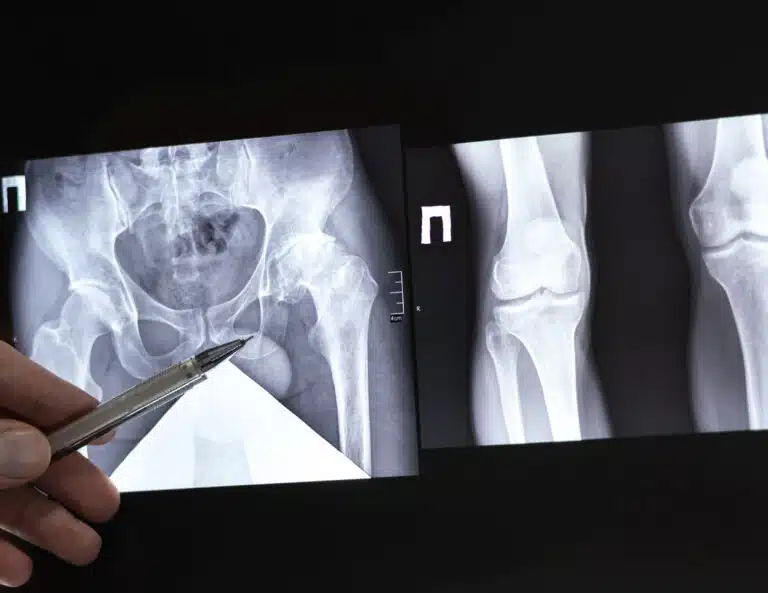
What is hip osteoarthritis?
The hip joint is composed of two components. The “male” component is the femoral head, which articulates with the “female” component, the hollow cavity of the pelvis known as the acetabulum. A smooth layer of cartilage covers these articular surfaces, allowing frictionless and fluid movement.
Coxarthrosis occurs when this cartilage thins and loses its mechanical properties. Eventually, bone rubs against bone, causing pain, reduced mobility, impaired quality of life, and sometimes night pain disturbing sleep.
Two main types are distinguished:
- Primary coxarthrosis: related to natural wear and aging
- Secondary coxarthrosis: resulting from anatomical abnormalities (hip dysplasia, femoroacetabular impingement) or previous trauma
What causes hip osteoarthritis?
Several risk factors may accelerate cartilage degeneration:
- Age: initial cartilage lesions may appear as early as 35 years old and accelerate after 50
- Morphological abnormalities: hip dysplasia and femoroacetabular impingement are well-established risk factors
- Trauma: sequelae of femoral neck or acetabular fractures can accelerate joint deterioration
- Mechanical overload: high-impact professional sports, intense amateur sports, heavy lifting, or obesity significantly increase joint stress
- Inflammatory rheumatic diseases: such as rheumatoid arthritis or ankylosing spondylitis
These factors may lead to premature cartilage wear – sometimes before the age of 40 (early coxarthrosis) – explaining why hip osteoarthritis can occur in younger patients.
What are the symptoms and how is it diagnosed?
The hallmark symptom is groin pain, located in the inguinal fold. It may radiate to the buttock, greater trochanter, thigh, or knee, which can create diagnostic confusion.
Warning signs include:
- Morning stiffness (needing to “loosen up” the joint)
- Increasing difficulty putting on socks or getting out of a car
- Limping while walking
Diagnosis is confirmed through clinical examination and imaging, including anteroposterior pelvic X-rays and lateral hip views. In selected cases, 3D imaging, MRI, or CT arthrography is used to precisely assess cartilage status before therapeutic decisions.
Non-surgical treatments: relieving pain and slowing degeneration
In early stages, treatment focuses on optimizing conservative management to relieve pain and slow progression:
- Physiotherapy and rehabilitation: essential for strengthening hip stabilizing muscles
- Adapted physical activity: swimming, cycling, and low-impact walking are recommended
- Weight loss: reduces mechanical load on the joint and cartilage stress
- Intra-articular injections: hyaluronic acid or corticosteroids may relieve pain. PRP (platelet-rich plasma) injections may be discussed in selected cases
These approaches often help prolong joint lifespan before considering surgery. We always prioritize conservative options when appropriate.
When should hip surgery be considered?
Total hip replacement (THR) is the only treatment that definitively resolves coxarthrosis. Surgery is considered when all conservative treatments become ineffective.
The decision is never taken lightly. It is based on a comprehensive clinical evaluation, imaging studies, and shared decision-making to determine the optimal timing.
In certain early cases, hip arthroscopy (joint-preserving surgery) may be sufficient. However, when cartilage is destroyed, total hip replacement becomes the gold standard treatment.
We prioritize an approach centered on anatomical preservation:
- Minimally invasive direct anterior approach : This surgical technique preserves anatomy without cutting muscles or tendons
- 3D planning and custom implants : We perform 3D preoperative planning using CT reconstruction to measure all patient-specific hip geometry parameters. A personalized femoral stem allows accurate reconstruction of each patient’s native anatomy
- Enhanced Recovery After Surgery (ERAS) protocol : Enhanced recovery protocols enable safe early discharge and accelerate overall rehabilitation
FAQ
Is hip osteoarthritis hereditary?
There may be familial predisposition, often related to inherited hip morphology (such as dysplasia) rather than the disease itself.
How long does a hip replacement last today?
Thanks to modern materials (ceramic bearings, highly cross-linked polyethylene), average implant survival now exceeds 20 to 25 years.
When can sports be resumed after surgery?
Walking is immediate. Swimming and cycling are possible within the first month, while more intense sports are discussed individually from the third postoperative month onward.
References :
- Hunter DJ, et al. Osteoarthritis. The Lancet. 2019.
- Griffin DR, et al. The Warwick Agreement on FAI syndrome. BJSM. 2016.
- Evans JT, et al. How long does a hip replacement last? The Lancet. 2019.
- Learmonth ID, et al. The operation of the century: total hip replacement. The Lancet. 2007.
- Parvizi J, et al. Total Hip Arthroplasty: Standardizing Outcomes. J Arthroplasty. 2019.
- Rathi R, Tourabaly I, Nogier A. Two-incisions direct anterior approach for THR: Surgical technique and early outcome. J Orthop. 2017